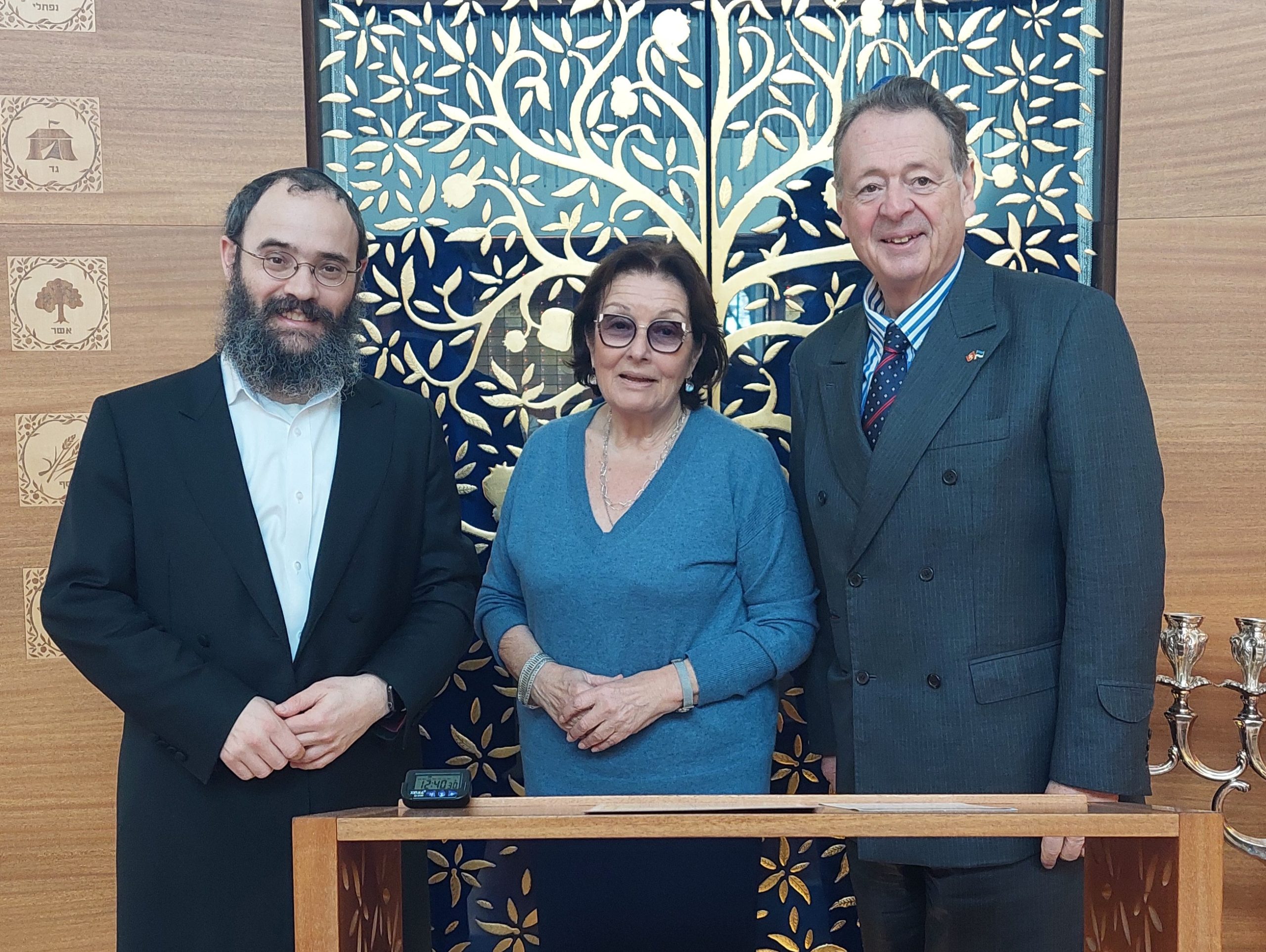
On October 29, the Ambassador visited Tallinn synagogue and had a meeting with the representatives of Tallinn Jewish Community – Chief Rabbi Shamuel Kot and Alla Jakobson, the Chairman of the Jewish Community.
The meeting took place in an open and friendly atmosphere. The Ambassador introduced the Order of Malta’s charitable mission throughout history, and especially during the most difficult moments in human history. He declared the readiness and desire to cooperate in Estonia to support vulnerable people and those in need in Estonian society.
Jakobson introduced the activities of the Jewish community in Estonia over the years and welcomed the Order of Malta’s desire and willingness to cooperate with each other in helping those in need.
The Ambassador invited Mrs. Jakobson, representatives of the Jewish community, to all official receptions and events of the Order of Malta Embassy and expressed the hope that Jewish youth would also find their way among the Estonian Maltesers.
Representatives of the Jewish community, for their part, promised to introduce various cooperation projects and opportunities for mutual partnership.
The Jewish community in Estonia is small but has a rich history, dating back several centuries. Despite periods of hardship, particularly during the Holocaust, the community has persevered and today plays an active role in Estonian society.
The first Jews are believed to have settled in Estonia in the 14th century, though a significant community began to form in the 19th century, especially after Estonia became part of the Russian Empire.
Estonia’s Jewish population grew following the 1865 lifting of residency restrictions on Jews in the Russian Empire.
After Estonia gained independence in 1918, the Jewish community enjoyed a period of cultural and religious freedom. In 1926, Estonia was the first country to officially recognize the Jewish community as an ethnic minority, granting cultural autonomy. Institutions such as Jewish schools, cultural societies, and synagogues flourished during this time.
The Holocaust devastated the Jewish population in Estonia. Nazi forces occupied the country in 1941, and nearly all of Estonia’s Jewish residents who had not fled to the Soviet Union were murdered. Estonia was declared “Judenfrei” by the Nazis by early 1942. Nazi forces also deported Jews to Estonia from other parts of Europe, many of whom were killed in concentration camps on Estonian soil.
After World War II, Estonia was annexed by the Soviet Union, and Jewish religious and cultural life was severely restricted. Many Jews who had fled to the Soviet Union during the war returned to Estonia, rebuilding a small community.
Following Estonia’s re-independence in 1991, the Jewish community regained the ability to openly practice its religion and cultural traditions. A revival of Jewish life began, supported by international Jewish organizations and local efforts.
Today, Estonia’s Jewish population is estimated at around 2,000 people, concentrated primarily in the capital, Tallinn, with smaller groups in Tartu and other cities.
The Tallinn Synagogue, rebuilt and opened in 2007, serves as the central hub for Jewish religious life. The Estonian Jewish Museum documents the history and contributions of Jews in Estonia. A Jewish Community Center in Tallinn organizes cultural and educational activities.
A Jewish school in Tallinn provides education that includes Jewish history, Hebrew, and cultural studies alongside a general curriculum.
Estonia has positive relations with its Jewish community, and antisemitism is relatively low compared to other European countries. The government actively works to commemorate Holocaust victims and combat antisemitism. Estonia observes International Holocaust Remembrance Day and has taken steps to preserve Jewish heritage sites. Jewish cemeteries and historical sites are maintained, and efforts continue to document and honor the community’s legacy.
Like many small Jewish communities, Estonia’s Jewish population faces challenges related to demographic decline, assimilation, and sustaining cultural traditions. However, Estonia’s embrace of religious and cultural diversity provides a supportive environment for the community to thrive.
The Jewish community in Estonia is a testament to resilience and adaptation. It contributes to Estonia’s multicultural fabric, preserving its heritage while actively engaging with broader society.